buonasera a tutti,come prevedibile prima o poi doveva capitare,da qualche giorno,random mi da "guasto sospensioni non superare i 50km/h" si abbassa tutta poi si rialza e mi elimina l'errore, me ne sono accorto che me lo fa quando supero gli 80 km/h ma non sempre. vorrei sapere se rimane in memoria questo errore in modo da capire cosa potrebbe essere e se a qualcuno è già capitato.
io ho ipotizzato che potrebbe essere la valvola che la fa abbassare che si incanta aperta e finendo l'aria si richiude, ma dove è montata questa valvola?
grazie a tutti



guasto sospensioni range rover vogue
8 messaggi
• Pagina 1 di 1
 il 01/11/2019, 11:32
non dando estremi per capire di che range tu stia parlando
risulta improponibile qualsiasi tipo di risposta .... a meno che il tuo futuro interlocutore sia un medium/sensitivo e/o che scartabelli i passati post
... anche se sono solo 12
cmq l' L322 ha una memoria per un TOT di messaggi di errore che si resettano nel tempo, solo la conce può darti responso e entità del danno con relativo preventivo da valutare poi in separata sede
calcolando che la concessionaria NON prevede NE' la revisione del compressore NE' una sostituzione con una unita OEM che costa 1/4 del costo del ricambio LR

risulta improponibile qualsiasi tipo di risposta .... a meno che il tuo futuro interlocutore sia un medium/sensitivo e/o che scartabelli i passati post
... anche se sono solo 12
cmq l' L322 ha una memoria per un TOT di messaggi di errore che si resettano nel tempo, solo la conce può darti responso e entità del danno con relativo preventivo da valutare poi in separata sede
calcolando che la concessionaria NON prevede NE' la revisione del compressore NE' una sostituzione con una unita OEM che costa 1/4 del costo del ricambio LR
God save the Queen
-
RangeRange
- Messaggi: 1733
- Iscritto il: 18/10/2010, 14:45
- Località: Padova
il 03/11/2019, 12:14
Questo quanto riporta il manuale di manutenzione... in ogni caso dubito che sia la valvola da te indicata.
SUSPENSION
Fault Detection
The air suspension ECU performs fault detection and plausibility checks. Fault detection is limited to faults that the ECU can directly measure, as follows:
- Sensor hardware faults
- Valve hardware faults
- Sensor and actuator supply faults l Bus failures
- ECU hardware errors.
Plausibility checks are checks on signal behaviour, as follows:
Average height does not change correctly
- Height changes too slowly
- Suspension moves in the wrong direction.
Reservoir pressure
- Does not increase when reservoir filling requested
- Does not decrease when reservoir used to lift vehicle l Does not decrease when reservoir is vented
- Pressure varies too much when inactive.
Compressor temperature
- Increases when compressor inactive
- Does not increase when compressor active.
'Energy' used to change height of corner
-Too much 'energy' used – height change takes too long or long term filtered height does not reach target.
Sensor activity
- Signal floating
- Inconsistent signal characteristics – signal on one side of axle is varying but other side remains static l Constant articulation when moving.
When a fault is detected, the ECU will attempt to maintain a comfortable ride quality with restricted functionality of the air suspension system.
The system functionality depends on the severity of the fault. The faults are defined as minor or major faults.
Minor faults are:
- Most sensor faults (hardware faults and plausibility faults) l Cross link valve failure
- Reservoir valve failure.
For most minor faults, height changes are inhibited except for a return to standard height. If the suspension is not in standard height, the ECU will respond to a request for manual or automatic height change to return the vehicle to standard height. The ECU will continue to level the vehicle at the 'current' ride height.
Major faults are:
- Compressor faults
- Plausibility errors – for example:
- Average height does not increase when lifting and the vehicle is moving. This could be caused by a
compressor fault or a fault in the reservoir valve.
- Reservoir pressure decreases when filling requested. This could be caused by a leak in the common gallery
in the valve block or connecting pipe.
For major faults the ECU will not level the vehicle at the 'current' ride height. The ECU freezes height changes until it receives a manual or automatic request for height change. The ECU will return to standard height and freezes once standard height is achieved.
If the air suspension ECU loses information regarding vehicle speed, the ECU cannot determine if the current ride height is suitable for the vehicle speed. The ECU immediately returns to the 'default' height, which is 20 mm below the standard height. Once at the default height, the ECU will continue to level the vehicle at this height. A loss of the speed signal could be due to a fault in the CAN Bus or a fault in the ABS ECU. It is unlikely to be a fault in the air suspension ECU. It may, for example, be caused if the battery is disconnected and the steering sensor is not recalibrated immediately after reconnection. In this case a CAN Bus fault is recorded in the error memory. If this fault is seen, other ECU's using the CAN Bus should be also be checked for faults. When the fault is repaired, the air suspension ECU will resume full functionality but the CAN error remains in the memory.
60-24 DESCRIPTION AND OPERATION
SUSPENSION
If the suspension is above the standard height and the air suspension ECU cannot lower the suspension or cannot determine the vehicle height, all height changes will be frozen. The ECU will issue a message on the CAN Bus which is received by the instrument pack which displays a maximum advisable speed in the message centre of '35MPH'. an immediate 'freeze' of the vehicle height is caused by the following:
- Failure of more than one height sensor
- Implausible articulation symptoms detected
- Valve or solenoid failure (does not include reservoir valve)
- Stuck corner or whole vehicle (diagnosed using plausibility of the sensor inputs).
If the air suspension ECU has a hardware fault, the ECU will disable all air suspension functions. Detectable hardware errors include memory error, ECU failure, calibrations errors.
Fault Messages
The air suspension has two methods which it can use to inform the driver of a fault in the air suspension system; the air suspension control switch LED's and the instrument pack message centre.
When minor faults occur and the air suspension ECU is able to level the vehicle to the 'current' ride height, the control switch LED's will display the current ride height. When the vehicle returns to the standard ride height and further height changes are disabled, the 'HOLD' LED in the control switch will be permanently illuminated.
The air suspension ECU suffers a major failure and there is no air suspension control, all the control switch LED's will remain unlit.
If a fault occurs and the ECU can determine the ride height and the vehicle is not above standard ride height, the driver will be notified via a 'AIR SUSP. INACTIVE' message in the message centre. If the ECU cannot determine the height of the vehicle, or the vehicle is above standard ride height and cannot be lowered, the 'AIR SUSP. INACTIVE' message is accompanied with an alternating 'MAX 35MPH' message.
SUSPENSION
Fault Detection
The air suspension ECU performs fault detection and plausibility checks. Fault detection is limited to faults that the ECU can directly measure, as follows:
- Sensor hardware faults
- Valve hardware faults
- Sensor and actuator supply faults l Bus failures
- ECU hardware errors.
Plausibility checks are checks on signal behaviour, as follows:
Average height does not change correctly
- Height changes too slowly
- Suspension moves in the wrong direction.
Reservoir pressure
- Does not increase when reservoir filling requested
- Does not decrease when reservoir used to lift vehicle l Does not decrease when reservoir is vented
- Pressure varies too much when inactive.
Compressor temperature
- Increases when compressor inactive
- Does not increase when compressor active.
'Energy' used to change height of corner
-Too much 'energy' used – height change takes too long or long term filtered height does not reach target.
Sensor activity
- Signal floating
- Inconsistent signal characteristics – signal on one side of axle is varying but other side remains static l Constant articulation when moving.
When a fault is detected, the ECU will attempt to maintain a comfortable ride quality with restricted functionality of the air suspension system.
The system functionality depends on the severity of the fault. The faults are defined as minor or major faults.
Minor faults are:
- Most sensor faults (hardware faults and plausibility faults) l Cross link valve failure
- Reservoir valve failure.
For most minor faults, height changes are inhibited except for a return to standard height. If the suspension is not in standard height, the ECU will respond to a request for manual or automatic height change to return the vehicle to standard height. The ECU will continue to level the vehicle at the 'current' ride height.
Major faults are:
- Compressor faults
- Plausibility errors – for example:
- Average height does not increase when lifting and the vehicle is moving. This could be caused by a
compressor fault or a fault in the reservoir valve.
- Reservoir pressure decreases when filling requested. This could be caused by a leak in the common gallery
in the valve block or connecting pipe.
For major faults the ECU will not level the vehicle at the 'current' ride height. The ECU freezes height changes until it receives a manual or automatic request for height change. The ECU will return to standard height and freezes once standard height is achieved.
If the air suspension ECU loses information regarding vehicle speed, the ECU cannot determine if the current ride height is suitable for the vehicle speed. The ECU immediately returns to the 'default' height, which is 20 mm below the standard height. Once at the default height, the ECU will continue to level the vehicle at this height. A loss of the speed signal could be due to a fault in the CAN Bus or a fault in the ABS ECU. It is unlikely to be a fault in the air suspension ECU. It may, for example, be caused if the battery is disconnected and the steering sensor is not recalibrated immediately after reconnection. In this case a CAN Bus fault is recorded in the error memory. If this fault is seen, other ECU's using the CAN Bus should be also be checked for faults. When the fault is repaired, the air suspension ECU will resume full functionality but the CAN error remains in the memory.
60-24 DESCRIPTION AND OPERATION
SUSPENSION
If the suspension is above the standard height and the air suspension ECU cannot lower the suspension or cannot determine the vehicle height, all height changes will be frozen. The ECU will issue a message on the CAN Bus which is received by the instrument pack which displays a maximum advisable speed in the message centre of '35MPH'. an immediate 'freeze' of the vehicle height is caused by the following:
- Failure of more than one height sensor
- Implausible articulation symptoms detected
- Valve or solenoid failure (does not include reservoir valve)
- Stuck corner or whole vehicle (diagnosed using plausibility of the sensor inputs).
If the air suspension ECU has a hardware fault, the ECU will disable all air suspension functions. Detectable hardware errors include memory error, ECU failure, calibrations errors.
Fault Messages
The air suspension has two methods which it can use to inform the driver of a fault in the air suspension system; the air suspension control switch LED's and the instrument pack message centre.
When minor faults occur and the air suspension ECU is able to level the vehicle to the 'current' ride height, the control switch LED's will display the current ride height. When the vehicle returns to the standard ride height and further height changes are disabled, the 'HOLD' LED in the control switch will be permanently illuminated.
The air suspension ECU suffers a major failure and there is no air suspension control, all the control switch LED's will remain unlit.
If a fault occurs and the ECU can determine the ride height and the vehicle is not above standard ride height, the driver will be notified via a 'AIR SUSP. INACTIVE' message in the message centre. If the ECU cannot determine the height of the vehicle, or the vehicle is above standard ride height and cannot be lowered, the 'AIR SUSP. INACTIVE' message is accompanied with an alternating 'MAX 35MPH' message.
Anyone can get a plane on the ground. Pilots just make sure you survive the event...
-
Sidestick72
- Messaggi: 3480
- Iscritto il: 16/06/2013, 13:12
- Località: Roma
il 03/11/2019, 12:19
Trova qualcuno vicino a te (devi specificare di dove sei) che abbia un "iidTool" che possa leggere che tipo di errore è rimasto in memoria, l'alternativa è Land Rover.
Le diagnosi tradizionali plurimarche non accedono agli errori del reparto sospensioni elettroniche delle Land
Le diagnosi tradizionali plurimarche non accedono agli errori del reparto sospensioni elettroniche delle Land
Anyone can get a plane on the ground. Pilots just make sure you survive the event...
-
Sidestick72
- Messaggi: 3480
- Iscritto il: 16/06/2013, 13:12
- Località: Roma
il 03/11/2019, 12:23
Altrimenti prova a fare la procedura indicata in grassetto e vedi se si ripete l'errore:
Motorway Ride Height
Motorway ride height lowers the vehicle by 20 mm, and improves the high speed handling of the vehicle. Motorway ride height is only active when the vehicle is travelling at more than 62 mph (100 km/h) for more than 30 seconds, and is not selectable by the driver.
If the vehicle speed falls to below 43 mph (70 km/h) for more than 60 seconds, the ECU automatically returns the vehicle to the standard ride height setting. If the vehicle stops while the motorway ride height is active, the timer is paused, stopping the vehicle rising unnecessarily.
Although motorway ride height isn't selectable by the driver, the 'Hold' switch can be used to keep the motorway ride height active, and prevent the automatic return to the standard ride height. The vehicle will return to the standard ride height once the 'Hold' switch is deselected (and vehicle speed is less than 43 mph (70 km/h).
Motorway ride height may be deselected by the driver at any speed by turning the rotary control switch upwards. The vehicle may return to motorway ride height if the vehicle speed remains greater than 62 mph (100 km/h) and the driver does not select 'Hold' when the vehicle has returned to standard ride height.
If the vehicle speed is within the required parameters, the driver can select access ride height by turning the rotary control switch downwards or pressing the access switch on the drivers door.
Motorway Ride Height
Motorway ride height lowers the vehicle by 20 mm, and improves the high speed handling of the vehicle. Motorway ride height is only active when the vehicle is travelling at more than 62 mph (100 km/h) for more than 30 seconds, and is not selectable by the driver.
If the vehicle speed falls to below 43 mph (70 km/h) for more than 60 seconds, the ECU automatically returns the vehicle to the standard ride height setting. If the vehicle stops while the motorway ride height is active, the timer is paused, stopping the vehicle rising unnecessarily.
Although motorway ride height isn't selectable by the driver, the 'Hold' switch can be used to keep the motorway ride height active, and prevent the automatic return to the standard ride height. The vehicle will return to the standard ride height once the 'Hold' switch is deselected (and vehicle speed is less than 43 mph (70 km/h).
Motorway ride height may be deselected by the driver at any speed by turning the rotary control switch upwards. The vehicle may return to motorway ride height if the vehicle speed remains greater than 62 mph (100 km/h) and the driver does not select 'Hold' when the vehicle has returned to standard ride height.
If the vehicle speed is within the required parameters, the driver can select access ride height by turning the rotary control switch downwards or pressing the access switch on the drivers door.
Anyone can get a plane on the ground. Pilots just make sure you survive the event...
-
Sidestick72
- Messaggi: 3480
- Iscritto il: 16/06/2013, 13:12
- Località: Roma
il 03/11/2019, 12:30
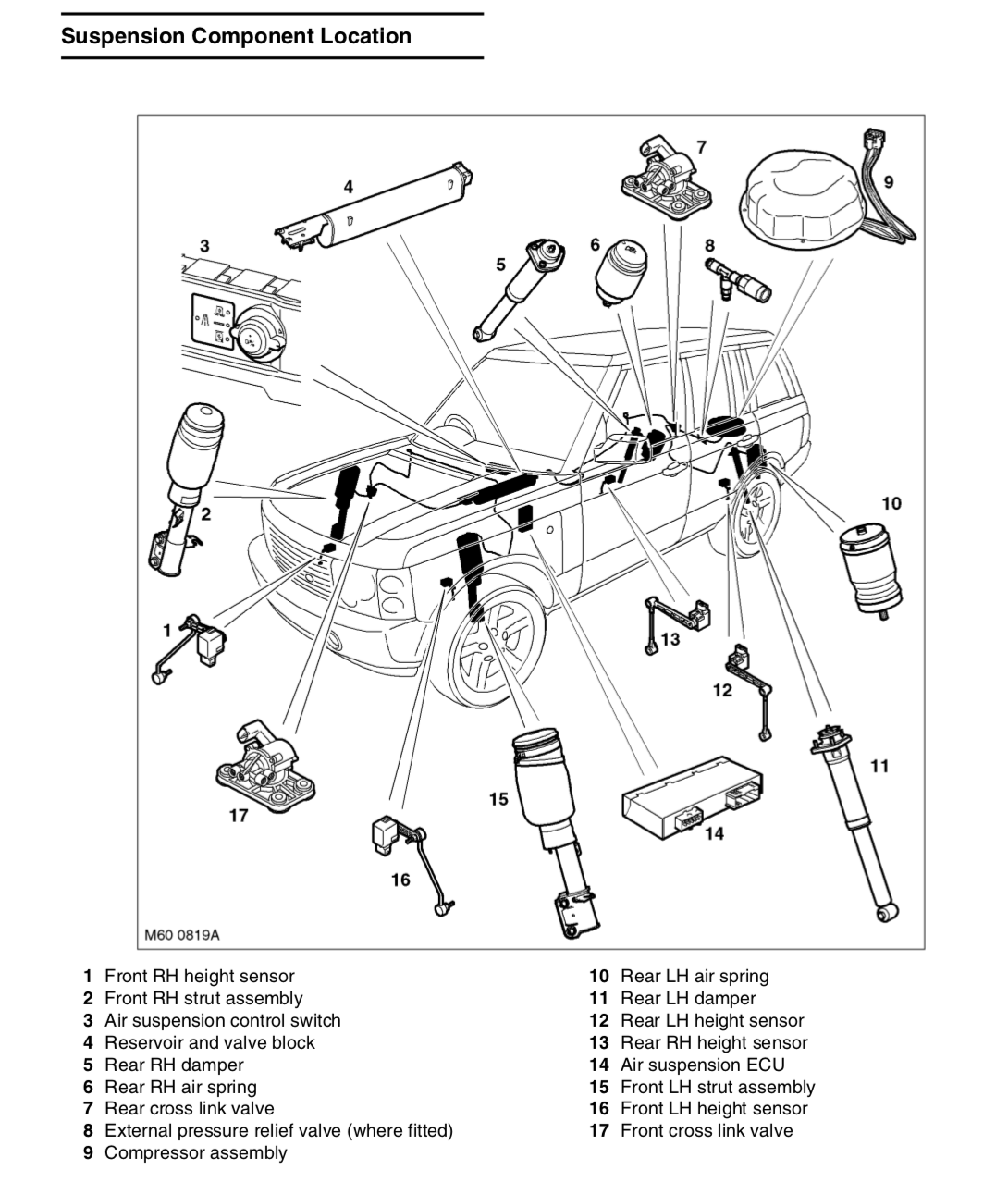
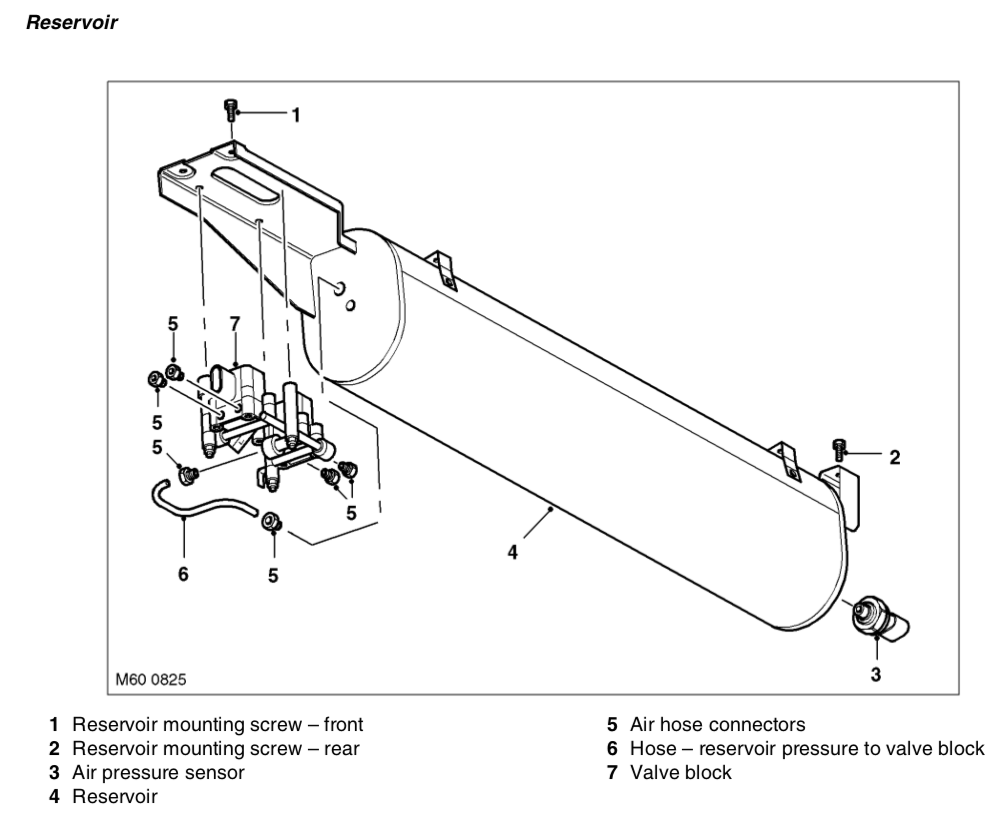
Infine la valvola di scarico dell'aria che stai cercando è attaccata al serbatoio dell'aria che si trova sotto l'auto, lato destro all'altezza dei piedi del passeggero porteriore. (n°4)
Anyone can get a plane on the ground. Pilots just make sure you survive the event...
-
Sidestick72
- Messaggi: 3480
- Iscritto il: 16/06/2013, 13:12
- Località: Roma
il 03/11/2019, 13:41
Grazie mille, credo che la miglior cosa da fare è fare una bella diagnosi, anche se l’officina land più vicina è a 100 km da Marzamemi
La procedura descritta è per il modello precedente dal 2002 al 2006 da me non c’è la possibilità di bloccare le sospensioni
La procedura descritta è per il modello precedente dal 2002 al 2006 da me non c’è la possibilità di bloccare le sospensioni
-
darioso
- Messaggi: 2294
- Iscritto il: 14/03/2005, 22:22
- Località: pachino(siracusa)
8 messaggi
• Pagina 1 di 1
Chi c’è in linea
Visitano il forum: Nessuno e 6 ospiti